
Reviews and Articles
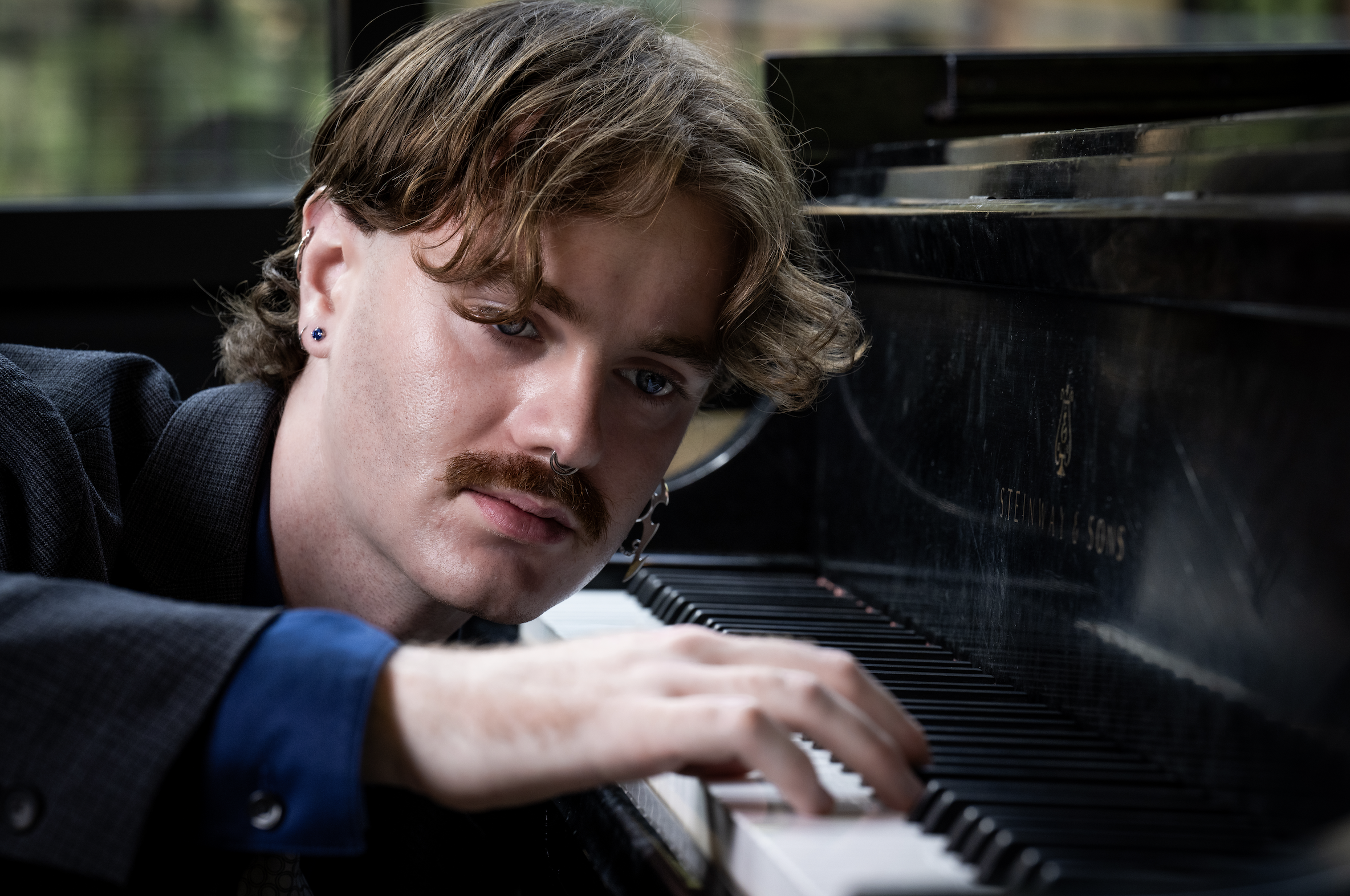
For aspiring recitalist Max Hammond, piano performance and mathematics offer variations on a thrill — testing the limits of possibility…
“I want to figure out what’s next in classical music,” said Hammond, a member of Silliman College and past winner of Yale’s Sharp Prize for “most outstanding performer in the junior class.”
Hammond’s tastes are broad: His current favorite composers include, on the one hand, Robert Schumann, the 19th-century Romantic, and, on the other, contemporary classical talents as György Ligeti, Unsuk Chin, and Alex Paxton.
Paxton’s work “ilolli-pop” is for Hammond “the absolute embodiment of joy — pure exuberance,” and, in a nod to his delight in contemporary music, Hammond began all his conservatory auditions with Ligeti’s “Etude No. 6: Autumn in Warsaw,” a technically challenging piece. Ligeti’s work sometimes “verges on the unplayable,” Hammond said — just how he likes it.
“I find the idea of brushing up against impossibility very exciting at the keyboard,” he said.
The opportunity to push boundaries is part of math’s appeal, too: “How do you make your mind do something you didn’t think it could do earlier in the day?”
To this end, he took such courses as “Intermediate Complex Analysis,” “Fields and Galois Theory,” and served as a peer tutor for four years.
He also sampled liberally from Yale’s other academic offerings, including nearly a second major’s worth of courses in women’s, gender, and sexuality studies.
For all his palpable excitement about Julliard, Hammond said Yale was the right place for his undergraduate experience.
“I want to have a lot of things to play about,” he said. “Yale has given me the space to think about what voice I have and what I want to use it to say in classical music.”
Happily, Yale itself is home to the renowned Yale School of Music, and Hammond has been able to enjoy the best of two worlds.
As a senior, for example, he was one of six students — and the only undergraduate — in a graduate-level music seminar focused on the study and performance of “Pierrot lunaire,” the Albert Schoenberg melodrama. It culminated in a live performance by the class at the Schoenberg Center — in Vienna — as part of the composer’s 150th birthday celebration.
“I’ve gotten this insane conservatory education at Yale,” said Hammond, who uses various pianos around campus but especially prizes the occasional chance to play on various Steinway D’s, 9-foot grand pianos.
Hammond’s Yale years have also afforded a start in professional life. At the tail end of his sophomore year, the New York-based vocal Mirror Visions Ensemble found itself without a pianist as it prepared for a major recording project. One of Hammond’s Yale mentors, Richard Lalli, recommended him.
“‘He’s a kid but I think he can do it,’” Hammond recalls Lalli saying.
Over two months, Hammond mastered an hour’s worth of music in time to record a video album with the group. That album, “Midnight Magic,” led to live performances in Los Angeles, New York, Paris, Scotland’s Isle of Arran, and elsewhere.
But, really, how does he fit it all in?
“I eat all my meals in 15 minutes,” he said.
As for his interest in circus acrobatics — a tale for another day.
Read a profile on Max, as one of the ten most outstanding Yale College graduates of 2024, by Eric Gershon: What’s Next in Classical Music? Max Hammond, for one
A review of Max’s performance of Schoenberg’s Piano Concerto Op. 42 with David Robertson and the Juilliard Orchestra as part of Juilliard’s Fall Fest, 2024 by Harry Rolnick for Concerto Net: Fear not the Dancing Dodecaphon
The second work was expected to be doom. I had heard Schoenberg’s Concerto once on YouTube and vowed never again. The reason? I had been reading that this was the most tone‑rowish/twelve‑note motif in the composer’s later repertoire. And I was trying to follow the transmutations of notes, the algebraic equations.
More the fool I. The young Max Hammond, playing without a score, started with three measures right out of Brahms. The rest of the Concerto, while certainly dissonant, certainly with measures of that single tone‑row, was, as they say on the lousiest radio stations, “Easy listening.” (Yuck)
The waltz was not hidden away as in Pierrot or the solo piano works. This opening waltz, with more major and minor keys, had a Straussian swing (Richard, not the Johanns). The following sections were more fragmented, but Mr. Hammond had two cadenzas which were more expressive than pyrotechnical. (Schoenberg wasn’t a terribly good pianist!). And after a Mahlerian short funeral march, it finished with almost jaunty happiness.
The Juilliard Orchestra was fine. But Mr. Hammond, without any hesitation, without even the illusion of difficulty, sailed through the Concerto with the finesse, the grace, the ebullience of a Mozart.
It was [Hammond’s] virtuosic accompaniment that really impressed. He displayed great skill and élan throughout. It’s easy to miss how much skill it takes to back, for example, Gilbert & Sullivan’s “My Name Is John Wellington Wells,” which baritone Mischa Bouvier sang with joyous comic mugging. Or to express with seeming ease the effervescent pianistic depiction of rain and lush foliage in Respighi’s “Pioggia,” sung delightfully by [Daniel] McGrew.
On Max’s work with Mirror Visions Ensemble’s Midnight Magic which hat its debut in Merkin Hall in 2022: Mirror Visions Ensemble’s Brilliant Return to the Concert Stage by Jon Sobel
On Max’s work with icarus Quartet premiering the program Bartók Reborn as a part of Wake Forest University’s Secrest Artist Series: The Secrest Artist Series Presents Bartók Reborn with icarus Quartet by Timothy Lindeman for the Cultural Voice of North Carolina
The performance was about as perfect as one could ask for: superior musicality with nuance, and a commitment to music-making as expressive as possible.